
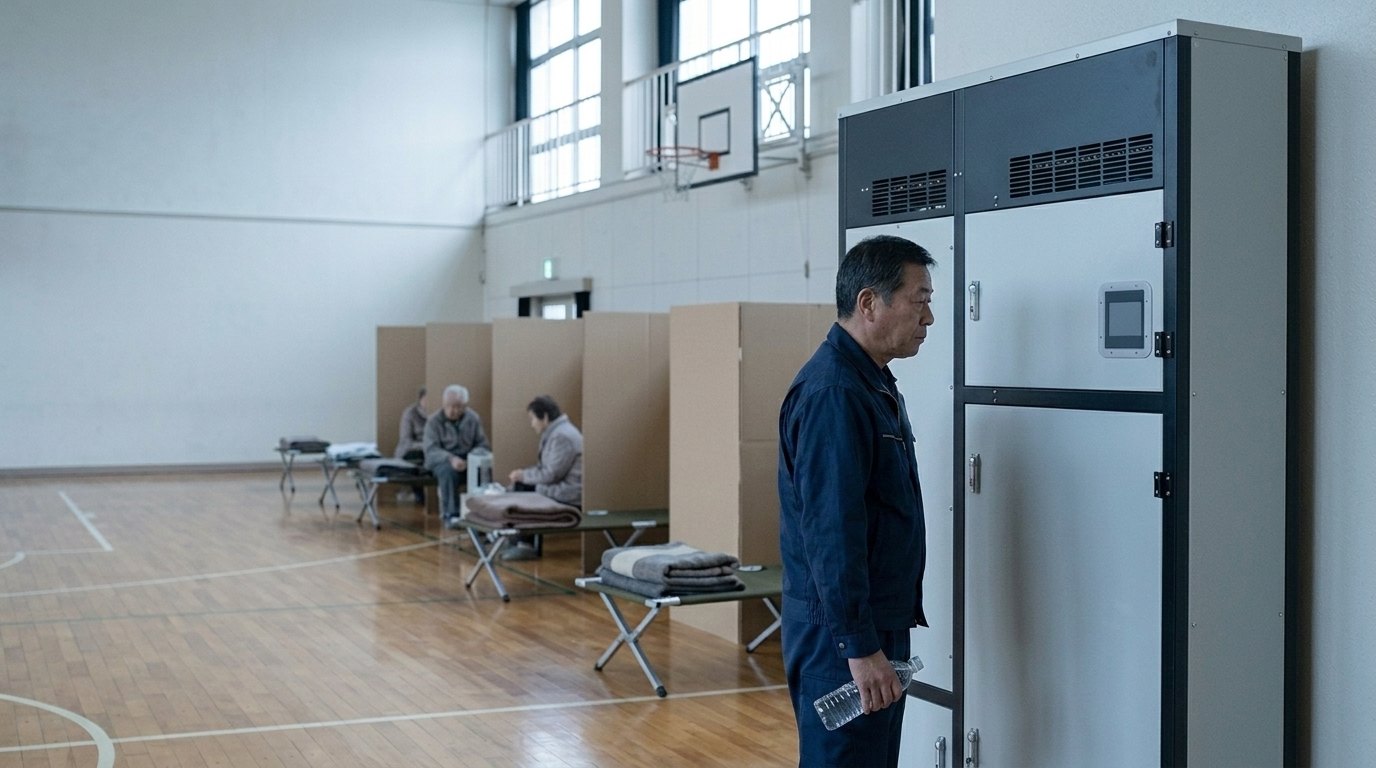
450,000 households lost water — Kumamoto, 2016
When the water stops, can your site keep running
Outages last far longer than plans assume.
Stockpiled water only shrinks. AirElixir keeps making more.
Includes a board-ready BCP proposal deck (PPT)
See how long outages really last- It doesn't run out Given air and electricity, it keeps producing water
- It doesn't stop Solar and battery storage keep it running through a blackout
- It doesn't sit idle Everyday drinking water for offices and factories
CONTRIBUTING TO THE SDGS

Outages are not measured in days
Power and gas may come back within days, but water is almost always last. The pipes are underground, so locating and repairing damage takes time. And water is the one lifeline that cannot stop, even for a day.
-
2016
Kumamoto Earthquake
450,000households
At its peak, roughly 450,000 households lost water. Much of the urban area was restored within about a week, but in the worst-hit areas restoration took months.
-
2024
Noto Peninsula Earthquake
Monthsof continued outage
A prolonged outage across a wide area, with sanitation at evacuation centres becoming a serious problem. We donated 10 AirElixir units to help supply drinking water.
-
Projected
Nankai Trough Megaquake
34.4million people
Government projections put the number of people losing mains water at up to 34.4 million. When damage is simultaneous and widespread, outside water support struggles to reach you.
The figures above are approximations based on published materials from Japan's Cabinet Office, Ministry of Health, Labour and Welfare and press reporting. Damage and restoration vary considerably by region.
Why stockpiled water runs short
A stockpile is only ever what you put in it. For a site of 100 people at 3 L per person per day, three days means 900 L; a week means 2,100 L. You carry that storage space, rotation effort and cost indefinitely — and it still runs out if the outage drags on.
| Criterion | Stockpiled water (bottled) | AirElixirWater from air |
|---|---|---|
| Supply volume | Capped at what you stored; shrinks as you distribute it | Generates every day for as long as it runs |
| If the outage drags on | Supply stops the moment it runs out | The longer it lasts, the more valuable it is |
| Storage space | Large space for headcount multiplied by days | Only the footprint of the unit |
| Maintenance | Rotation and disposal costs at every expiry date | Replacing filters and other consumables only |
| During a blackout | Unaffected — but the volume never increases | Runs independently on solar plus storage |
| Use in normal times | Storage only; sits unused | Serves as everyday drinking water |
A stockpile is preparedness that shrinks. AirElixir is preparedness that keeps growing.
Used together, they cover water supply without a gap — from the first hours through a prolonged outage.
Three reasons it works for BCP
A shift from hauling water in to making it on site. Supply continues even when the infrastructure does not.
-
It doesn't run out
Given air and electricity, it keeps producing water. Preparedness that never has you counting down the days left makes a decisive difference in a prolonged disaster.
-
It doesn't stop
Integrated with solar panels and battery storage, it runs independently through a blackout. The days right after a disaster, before grid power returns, are exactly when it keeps water flowing.
-
It doesn't sit idle
In normal times it supplies everyday drinking water for offices and factories. Unlike a stockpile that expires unused, your preparedness turns into daily value.
Where you put it decides what you protect
Offices, factories, municipalities, healthcare. What you most need to protect when the water stops determines the right location and scale.
-
Head office & workplaces
Drinking water for employees, plus capacity to shelter people unable to get home. It makes your duty of care something you can actually deliver on.
-
Factories & logistics hubs
Minimises losses from halted operations, and covers large headcounts including on-site contractors.
-
Municipalities & shelters
As a water point for designated evacuation centres. The harder it is for water trucks to reach an area, the more producing on site is worth.
-
Healthcare & care facilities
Dialysis, infant formula, hygiene control — settings where water is tied directly to life. An outage threatens the continuity of care itself.
Choose by the number of people you protect
These guides assume 3 L of drinking water per person per day. If you also need water for washing and sanitation, we will recommend a larger model.
| Model | Daily output* | People served** | Typical site |
|---|---|---|---|
| AirElixir-20 | 20 L | approx. 6 | Small offices, shops, homes |
| AirElixir-80 | 80 L | approx. 26 | Restaurants, clinics, small workplaces |
| AirElixir-100 | 100 L | approx. 33 | Public facilities, small shelters |
| AirElixir-250 | 250 L | approx. 83 | Workplaces, healthcare, agriculture |
| AirElixir-1000Recommended | 1,000 L | approx. 330 | Head offices, factories, designated shelters |
| AirElixir-5000 | 5,000 L | approx. 1,600 | Large factories, regional hubs, community infrastructure |
- Daily output is each model's maximum generation capability (a theoretical figure). Actual output varies considerably with temperature, humidity, air circulation and operating rate. We provide a free output simulation for your proposed site.
- People served is a guide calculated at 3 L of drinking water per person per day. Requirements increase if water for washing and sanitation is included.
Four steps to installation
We handle everything from first conversation through installation and start of operation. Begin by telling us about your current BCP and site conditions.
-
Discovery
We review headcount, installation environment, power supply and your current stockpile. Ask us about alignment with your existing BCP as well.
-
Output simulation
Using temperature and humidity data for the proposed site, we estimate expected output free of charge and firm up the model and number of units.
-
Quotation & contract
We present a total figure including installation work and power configuration, such as whether solar is needed. Materials for internal approval are included.
-
Installation & handover
We install, commission and walk you through operation, handing over procedures for both everyday use and emergencies.
Frequently asked questions
Can it produce water during a power outage?
Yes. Combined with solar panels and battery storage, it operates independently during a blackout. We design configurations that keep producing in disaster areas where grid power has not yet been restored. At our demonstration site in Tomisato, Chiba Prefecture, the system is paired with 220 monocrystalline panels and runs entirely on self-supplied power.
Is the water safe to drink as produced?
Yes. Incoming air is cleaned through high-performance filters, and the condensed water passes through multi-stage filtration, UV sterilisation and mineral addition. It is designed to produce drinking water meeting the standards of Japan's Food Sanitation Act.
Does it still work in winter when humidity is low?
Output varies with temperature, humidity, air circulation and operating rate. The daily capacity shown for each model is its maximum generation capability; actual output depends on the installation environment. We provide a free output simulation based on the climate data for the site you are considering.
What can it be used for in normal times?
In normal times it provides everyday drinking water for offices and factories. There is no need to rotate and replace stock as it reaches its expiry date, and being useful daily while still serving as preparedness is the key difference from stockpiling.
How much space does installation require?
It depends on the model. We offer six models, from the AirElixir-20 for small offices to the AirElixir-5000 for regional evacuation hubs. After reviewing your installation environment — indoor or outdoor, power supply and drainage — we recommend the most suitable model and installation plan.
Does this make our existing stockpile unnecessary?
No — we recommend using both. Stockpiled water is strong in the immediate aftermath, while AirElixir comes into its own as an outage lengthens. Because their roles differ, combining them covers water supply without a gap from the first hours through to recovery.
Get the BCP guide
Materials, a site-specific simulation or an online consultation — whichever you need. A member of our team will reply within one business day.
-
BCP proposal deck for internal approval (PPT) Outage risk and return on investment, ready to present internally
-
Site-specific output simulation Expected output modelled on your site's temperature and humidity
-
Water requirement worksheet by scale Work out the model and unit count from your site headcount
-
Quotation Prepared individually once we know your site, power setup and unit count